Agentic Workforce
Activate specialized payment agents to work across your operation
Five agents optimize approval, cost, checkout, reconciliation and disputes
— 24/7, within your rules.
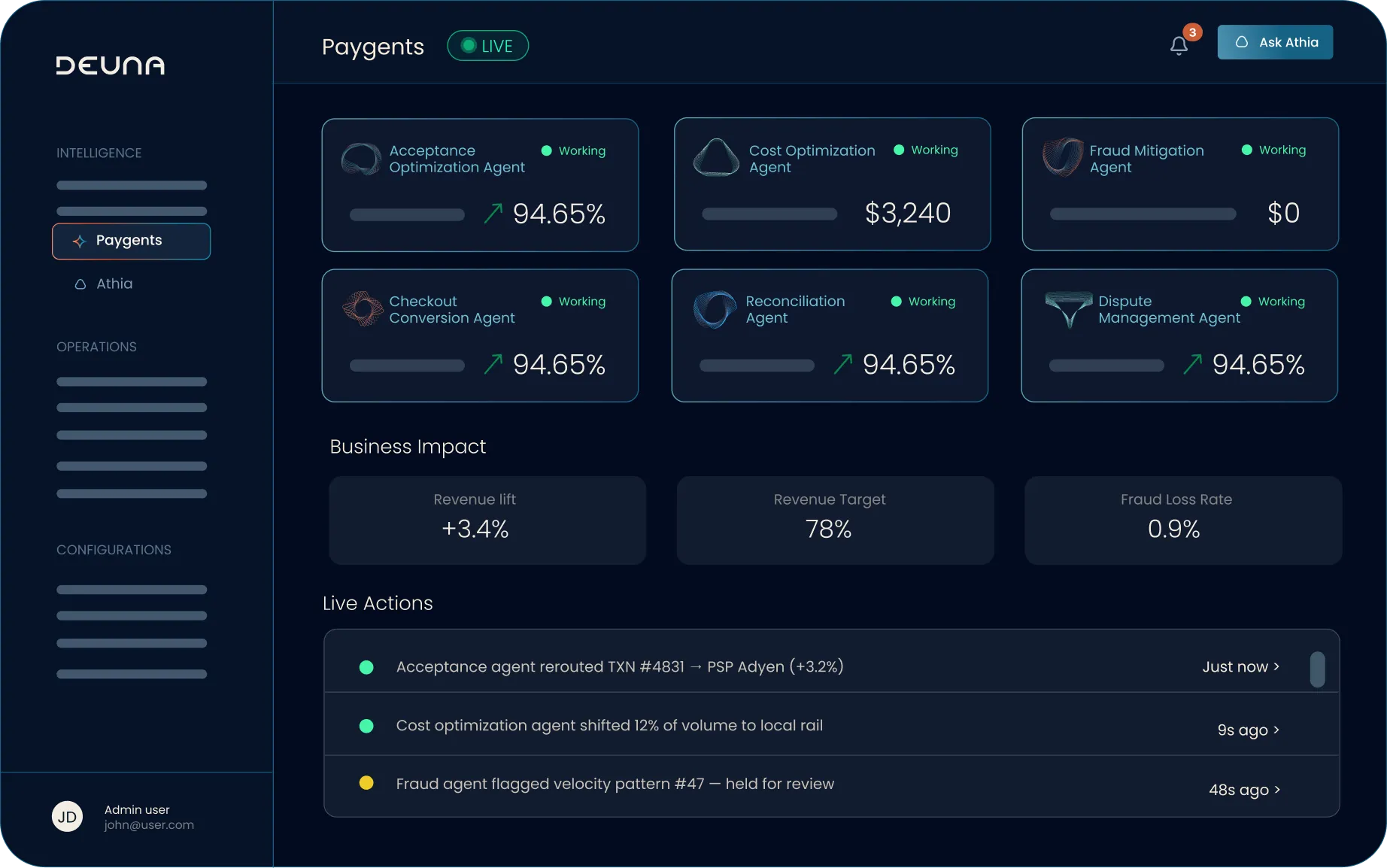
Agentic optimization.
Agents monitor and act across the payment lifecycle — transaction by transaction.
You stay in control.
Agents operate within the commercial, risk and operational guardrails you define.
Your stack. Now agentic.
Plug in your existing payment infrastructure and turn it into an AI-powered execution layer.
Five specialists. One objective.More value from every payment.
24/7 agents that monitor, decide, and act on your payment stack. Always on, always working, always inside your rules.
Features & Capabilities
Meet the agents.

Conversion Optimization Agent
Turn every checkout into its highest-converting version.
Agent adapts the payment experience to each shopper and transaction.
• Prioritizes the payment methods most likely to convert by user, order and market.
• Reorders checkout elements dynamically based on session context.
• Enables one-click checkout for recognized users, even without login.

Acceptance Optimization Agent
Push every transaction toward its highest approval.
Agent determines the acceptance maximizing strategy for each transaction.
• Predicts the best route for every transaction using AI and live performance signals.
• Optimizes message configuration and retries by issuer and rejection pattern.
• Improves MIT acceptance by optimizing charge timing and retry strategy.

Cost Optimization Agent
Protect margin on every payment.
Agent balances approval probability and processing cost for every transaction.
• Finds the lowest-cost viable route without sacrificing acceptance.
• Shifts eligible volume to lower-cost rails such as PINless or local acquiring.
• Detects fee leakage and inefficient routing as provider economics change.

Reconciliation Agent
Automate reconciliation across your entire payment stack.
Agent brings fragmented payment evidence together and focuses teams on what actually needs attention.
• Matches transactions, settlements, fees, refunds and chargebacks automatically.
• Detects missing, delayed, duplicated and mismatched records.
• Classifies exceptions by root cause, provider and financial impact.

Disputes Agent
Turn fragmented disputes into clear action.
Agent consolidates dispute data and surfaces where teams should focus.
• Unifies disputes across providers in one view.
• Flags high-priority cases, deadlines and emerging patterns.
• Surfaces the context teams need to decide where to act.
How it works
Agents act. You stay in control.
Agents execute against the policy layer you define — never outside it.
Honor provider commitments automatically, including minimum volumes, caps and exclusivities.
Enforce market and payment rules by country, method, 3DS requirements and risk policy.
Respect operational constraints, including processor availability, routing eligibility and technical limitations.
How to enable Agents
Connect your stack. Make it agentic.
Already using DEUNA’s orchestration?
Agents are built in. Contact your account manager to get started.
Using your own infrastructure?
Connect the data, define your policies, and consume agent decisions through API — without rebuilding your payment stack.
Get started in 3 steps →Need DEUNA’s infrastructure?
Explore how DEUNA’s infrastructure can power the agents.
01.
Connect your data
Feed the agents directly from your processors reports or from your existing data sources.
Processors: Native API connections
Warehouses & data platforms: API or SFTP
02.
Define your policies
Set the commercial, operational and risk rules agents must operate within.
03.
Put agent decisions to work
For Acceptance, Cost and Checkout, consume transaction-level decisions through API within your existing payment flow.
For Reconciliation and Disputes, agents enable reports and analytics in your dedicated platform.
Security, compliance & data privacy.Built for enterprise trust. Designed for data protection.
Enterprise-grade security, verified compliance, and privacy-first architecture are built into every layer of the platform — keeping your data isolated, protected, and ready to scale with confidence.
Read more about Security & Compliance




Learn more
Frequently Asked Questions & Answers
What data do agents need to make effective decisions?
It depends on the agent. Agents use historical data relevant to the decision they are optimizing, enriched with business context and constraints.
Do we need to use DEUNA’s payment infrastructure to deploy the Agentic Workforce?
No. Agents can operate on DEUNA infrastructure or integrate with your existing payment stack. You can add DEUNA’s decisioning layer without rebuilding your current architecture.
How can we connect our data to the Agentic Workforce?
DEUNA supports native processor integrations, data-platform connections such as Snowflake and Databricks, and secure SFTP ingestion. The required connection depends on the workflow, while DEUNA handles the normalization needed to make the data usable by the agents.
How is our data protected?
DEUNA applies enterprise-grade controls across access, encryption, data isolation, auditability, and sensitive-data handling, supported by PCI DSS 4.0.1, SOC 1, SOC 2, ISO 27001:2022, and GDPR requirements.
How do agents connect to and act across our existing payment stack?
For transaction-level decisioning agents such as the acceptance agent, DEUNA exposes APIs that feed agent decisions directly into your existing orchestration layer. Other agents, such as reconciliation, can operate directly on your data without sitting in the transaction flow.
How do agents account for our business rules and commercial commitments?
Every agent operates through a policy layer that encodes the conditions it must respect—including processor volume commitments, routing restrictions, geography, payment method, risk requirements, and operational constraints. Your business will always be in control on the boundaries the agentic workforce needs to respect.
What guardrails can we define for agent actions?
You define where agents can act, what they can change, and the boundaries they must respect. Agents begin acting on contained traffic before scaling, allowing performance to be proven while operational risk remains controlled.
