
Every payment involves a chain of decisions. Which payment methods to show a shopper. Which route to send the transaction through. Whether and when to retry. How to match what was charged with what was settled. Across thousands of transactions a day, each of those decisions shapes approval, cost and the value a business gets from every payment.
Agentic optimization brings a new way to handle them. Specialized payment agents monitor and act across the payment lifecycle, transaction by transaction, 24/7 and always within the rules a business defines.
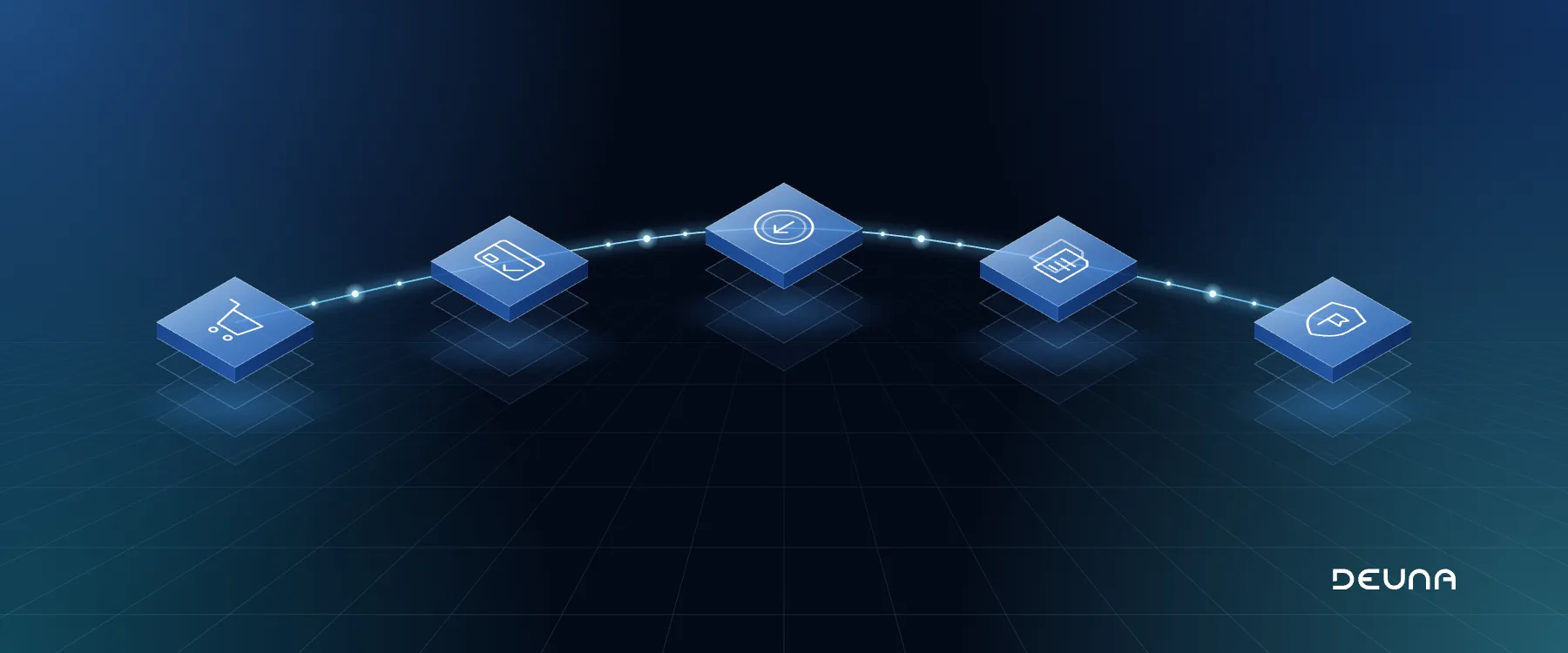
Agentic optimization is the use of AI agents that monitor, decide and act on a payment stack. DEUNA’s Agentic Workforce is made up of five specialized agents, each focused on a stage of the payment lifecycle: conversion, acceptance, cost, reconciliation and disputes.
Agents build on the visibility payments teams already have. Data and analytics show what is happening; agents add a layer that reasons on that information and acts on it, one transaction at a time. Five specialists, working toward one objective: more value from every payment.
The lifecycle starts at checkout. The Conversion Optimization Agent adapts the payment experience to each shopper and transaction, with one goal: turning every checkout into its highest-converting version. It:
Once a shopper pays, the Acceptance Optimization Agent determines the acceptance-maximizing strategy for each transaction. It predicts the best route using AI and live performance signals, and optimizes message configuration and retries by issuer and rejection pattern.
For recurring and stored-credential payments, it also improves merchant-initiated transaction (MIT) acceptance by optimizing charge timing and retry strategy.
Approval and cost are closely linked, and the Cost Optimization Agent balances both for every transaction. It:
The lifecycle continues after a payment is approved. The Reconciliation Agent brings fragmented payment evidence together. It matches transactions, settlements, fees, refunds and chargebacks automatically, detects missing, delayed, duplicated and mismatched records, and classifies exceptions by root cause, provider and financial impact. Teams can focus on what actually needs attention.
The Disputes Agent unifies disputes across providers in one view. It flags high-priority cases, deadlines and emerging patterns, and surfaces the context teams need to decide where to act.
While the first three agents deliver decisions inside the transaction flow, these two operate directly on payment data and enable reports and analytics in a dedicated platform.
Acting across the lifecycle does not mean acting without limits. Every agent executes against a policy layer the business defines, never outside it. That layer helps agents:
Businesses define where agents can act, what they can change and the boundaries they must respect. Agents begin on contained traffic before scaling, so performance can be proven while operational risk stays controlled.
Agentic optimization does not require rebuilding existing infrastructure. For businesses already using DEUNA’s orchestration, agents are built in. For those running their own infrastructure, enabling agents takes three steps:
Each stage of the payment lifecycle holds its own opportunities, and agentic optimization puts a specialist on each one: always on, always working, always inside your rules.
Curious how DEUNA’s payment agents could work across your operation? Book a demo.