
Picture a payments team a quarter after the integration project closes. Multiple PSPs live, regional coverage in place, no single point of failure, engineering finally free to build something else.
Then the review lands, and authorization and cost per transaction sit roughly where they started. Nothing broke. Nothing improved either.
That outcome is not a failure of orchestration. It is orchestration doing what the first wave was designed to do. Connectivity removed a constraint. What it left behind was a set of rules deciding where transactions go, and those rules were written once.
Five providers only create value if something chooses between them on every transaction, for a reason that still holds today. That is the difference between a wider payment stack and a smarter one, and it is where payment orchestration is heading next.
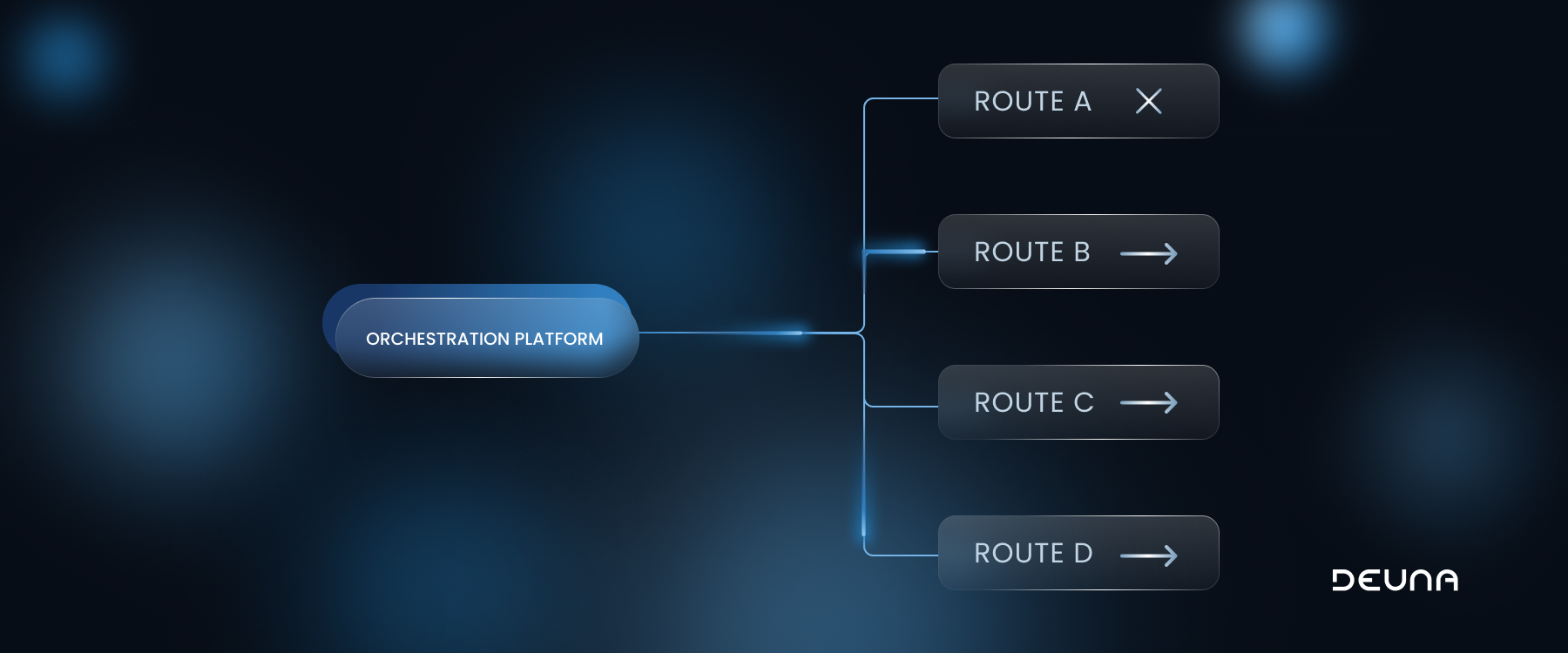
The first wave targeted integration complexity. One platform, multiple providers, less engineering effort, faster expansion, and basic routing to distribute traffic across them.
That last part matters, because it is where the limitation lives. The first wave did make decisions. It made them with static logic: rules configured at a point in time, reflecting the ecosystem as it looked when someone wrote them down.
Connectivity gives you access to the layers of a transaction. It does not give you a view across them, or a say in what happens between them.
Payments is not a single system. It is a sequence of decisions distributed across merchant, gateway, processor, network, issuer, fraud systems, and authentication layers like 3DS. Authorization resolves in milliseconds, shaped by variables most stacks never see.
So merchants optimize what they can measure. Approval rate moves half a point, the quarter looks fine, and the real drivers stay underneath. The leak is invisible because the surface metric looks healthy.
The next wave is not about moving transactions. It is about orchestrating decisions across the transaction lifecycle. Three things have to work together:
Capgemini's World Payments Report 2026 arrives at the same conclusion from a different angle. Analyzing how banks can compete against more agile platform players for merchant business, the report identifies orchestration as a differentiator specifically because of what it does with decisions: routing transactions dynamically, cutting downtime, and lifting conversion. The value sits in the decision, not the connection.
Visa's Acquirer Monitoring Program shows how fast the ground moves underneath merchant logic.
VAMP went live on April 1, 2025, consolidating the Visa Dispute Monitoring Program and the Visa Fraud Monitoring Program into a single combined fraud and dispute ratio. On April 1, 2026, Visa lowered the Excessive merchant threshold from 220 basis points to 150 basis points across the United States, Canada, Europe, and Asia Pacific.
Nothing about the merchant changed. A merchant at 1.8% in March was compliant. In April, with identical volume and identical dispute counts, that same merchant is over the line.
Declining more aggressively does not solve it either. Rejecting legitimate transactions shrinks the denominator of that ratio without touching the numerator, which can push a merchant further out of compliance while also costing the sale.
Consumer behavior moves on its own timeline. Worldpay's Global Payments Report 2026 found digital wallets now account for 40% of United States e-commerce spend, and in Asia Pacific they reached 77% of online spend in 2025, the highest share of any region. Payment method mix, issuer behavior, and fraud patterns all keep shifting.
Rules written against last year's reality do not fail loudly. They become progressively less right, and the gap widens quietly over months.
When orchestration shifts from connectivity to decisioning, the merchant's relationship to payments changes structurally. Four implications follow:
In Latin America this is a requirement, not a refinement. Local payment methods, issuer behaviors, and regulatory environments vary widely enough that a static approach does not scale at all.
Decisioning is not the end of the arc. The direction the industry is pointing toward is autonomy: routing strategies that rebalance themselves against issuer and PSP performance signals, retry logic that separates recoverable from non-recoverable declines as they happen, 3DS applied as a precision tool rather than a blanket rule.
That shift is still underway. But the premise behind it already holds today, and it is the lesson worth taking from all of this: most payment failures are not inevitable. They are the output of misaligned data, suboptimal routing, and delayed decision-making. Those have causes, and causes can be addressed.
Which reframes the question for any enterprise merchant. Not "how do we connect to more providers," but "what decides, and how fast does it learn."
DEUNA works on that question. Not by replacing the PSPs and fraud tools already in place, but by unifying what they see so the comparison between them means something. Athia builds on that foundation.
Connectivity got you optionality. Decisioning is what turns optionality into performance, and that is the difference between a stack that plateaus and one that keeps improving.