
Airlines process around USD 1 trillion in payments every year, and it costs them USD 22 billion to do it, according to IATA's June 2026 Payment Services fact sheet. About USD 18 billion of that, or 80%, goes to payment fees. For an industry with thin margins, how each transaction is processed is not a back-office detail. It is one of the few cost lines airlines can actually influence.
Payment orchestration is the infrastructure that makes that possible. Here is how it works.
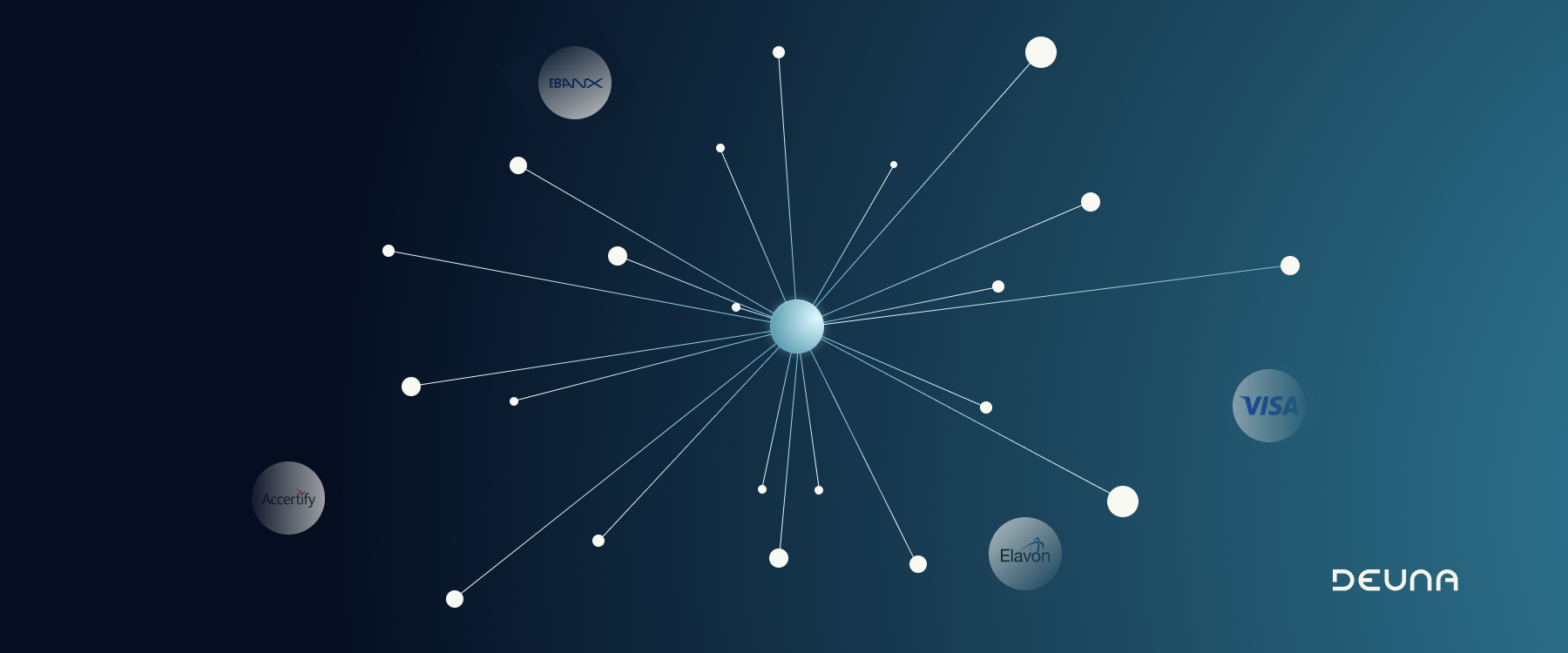
Payment orchestration is a layer that sits between an airline and all of its payment providers. Instead of connecting separately to each payment service provider (PSP), acquirer, alternative payment method, and fraud tool, the airline connects once to the orchestration layer. That layer then decides, transaction by transaction, where each payment should go.
This matters for airlines because every booking can involve a different country, currency, card type, and customer profile. No single fixed setup is the best option for all of them.
The airline integrates once. Through that connection, it can enable PSPs, acquirers, alternative payment methods, and antifraud providers. DEUNA, for example, connects merchants to more than 400 providers through a single integration. Adding a new provider or a local payment method for a new market becomes a configuration step, not a new engineering project.
Once providers are connected, the airline defines how transactions are routed: by region, currency, card type, cost, or its own business logic. With no-code workflow tools, payment teams can create and adjust these rules without waiting on development cycles. A transaction from one market can go to the provider with the strongest approval performance there, while another goes to the most cost-effective option.
Not every failure is final. When a transaction fails because of a false fraud positive or a network error, orchestration can retry it automatically instead of letting the booking fall through.
Because every transaction runs through the same layer, the airline gets end-to-end traceability across providers. Refunds, captures, and voids, full or partial, can be handled from one console or via API. In an industry where changes, cancellations, and refunds are part of daily operations, that single view simplifies both customer service and reconciliation.
UATP (Universal Air Travel Plan) is a travel payment network owned by the airline industry and used mainly for corporate travel. It offers lower transaction costs than commercial card networks, plus detailed line-item data. Yet many airlines underuse it, because supporting it traditionally meant another integration.
With orchestration, UATP becomes one more connection. In DEUNA, once the airline has its UATP credentials, it names the connection, decides whether to tokenize guest cards, chooses whether to create settlements, and selects the operation type: purchase or authorization. Its settlement and line-item data then flow into the same reconciliation view as every other payment method.
Rules are only as good as the information behind them, and static rules do not adjust on their own when approval rates shift by issuer, route, or season. Athia, DEUNA's agentic payments intelligence, reads across the unified transaction data and identifies when routing a payment to a lower-cost or higher-approval rail would improve the outcome. Orchestration provides the connections. Intelligence helps decide how to use them.
The key takeaway for airline payment teams is that no single provider or network is the right choice for every transaction. The cheapest transaction is the one routed to the lowest-cost rail that still gets approved. Payment orchestration turns that principle into daily operations: one integration, flexible routing, automatic retries, and a single view of every payment.