
Payment teams track dozens of metrics. Approval rates, decline rates, fraud rates, chargeback ratios, processing costs. These are the numbers that show up in weekly reports and quarterly business reviews. They are all lagging indicators. By the time they reflect a problem, the revenue has already leaked.
There is one metric most payment teams are not measuring that has more predictive power than any of the above. Decision latency: the time between when a performance issue emerges in your payment data and when your team takes action on it.
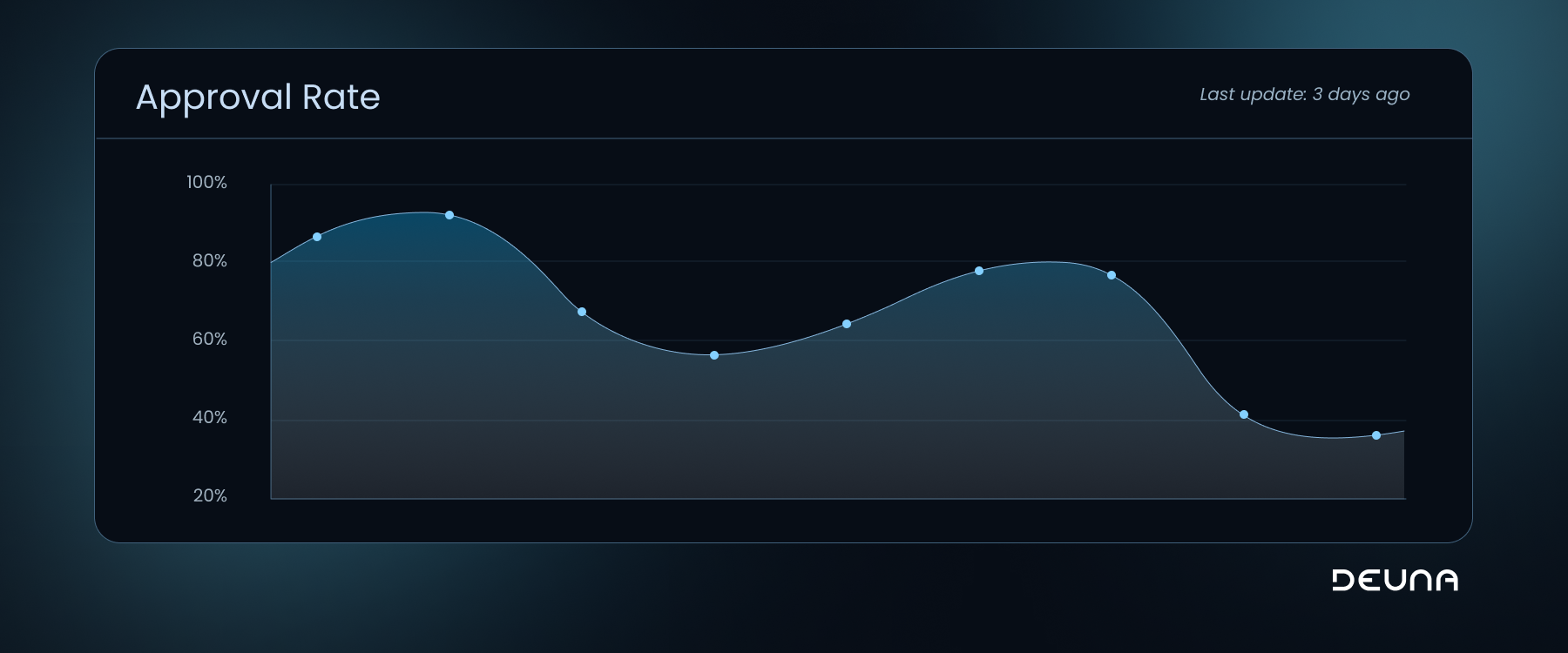
Authorization decisions happen in under 200 milliseconds, according to Mastercard's Decision Intelligence documentation. Issuer behavior shifts in hours. A BIN range that performed at 94% approval yesterday may be sitting at 89% today because a major issuer tightened its fraud filters overnight for a specific merchant category.
In a traditional payment operations setup, that drop does not surface until someone pulls a report. If reporting runs weekly, the team is operating on seven-day-old data. If it runs daily, it is still 24 hours behind. During that window, every transaction in that BIN range is hitting the same wall, and the revenue loss is compounding transaction by transaction.
That gap between signal and action is decision latency. And for most enterprise merchants, it is measured in days, not minutes.
Measuring decision latency requires answering three questions honestly.
How long does it take for a performance shift to appear in your reporting? If your data consolidation across PSPs is manual, the answer is likely days. If it is automated but runs in batch, it may be hours. Real-time visibility across all providers is the starting point.
How long does it take to implement a fix once the root cause is identified? If routing changes require an engineering ticket, the answer could be days. If they require a manual rule update in each provider's console, it is still significant overhead.
Systems that once executed transactions in sequence are being redesigned to interpret data, manage credentials, and optimize routing decisions in real time. The merchants who have closed the decision latency gap are the ones who have made that transition. Those still operating on batch reporting and manual rule updates have not.
The payment teams with the lowest decision latency have three aspects in common.
They have a unified data layer across all providers. Not a dashboard per provider, but a single normalized view where every transaction from every processor appears under the same definitions and the same time axis. Without this, diagnosis is guesswork.
They have routing logic that can change without an engineering ticket. When the diagnosis is complete, the fix needs to go live in minutes, not days. Modern routing solutions use machine learning to analyze transaction patterns and recommend optimized sequences, adjusting priority order based on real-time responsiveness to live transaction data rather than historical averages.
They have a system that closes the loop automatically for patterns that are already understood. Not every performance shift requires human diagnosis. An issuer that consistently underperforms for a specific BIN range during a specific time window is a pattern a system can learn and act on without waiting for a human to notice it in a report.
Decision latency does not just cost you the revenue lost during the detection window. It costs you the compounding effect of operating on stale routing logic longer than necessary. A one percent improvement in approval rates for a business processing 1B dollars annually recovers one hundred thousand dollars in revenue that cost nothing to acquire. For larger merchants, a two or three point gain can add millions to the bottom line. Every day of decision latency is a day those gains are delayed.
Decision latency is not a technology problem. It is an organizational one. Most payment teams have the data. What they lack is the infrastructure to act on it at the speed payments demand.
Closing that gap starts with knowing where yours stands today. How long does it take your team to go from signal to action? If the answer is measured in days, the revenue implications are already showing up in your approval rates, whether you can see them or not.
DEUNA was built to close that gap. Not by adding another dashboard to your stack, but by replacing the detect, investigate, patch, repeat cycle with a system that reasons and acts continuously through Athia, our payments intelligence engine. The result is a payment operation that stopped explaining last week and started improving this one.