
"Agentic" is now attached to almost every product in payments, often with no clear definition behind it. The term is worth pinning down, because it describes a specific capability: a system that not only surfaces what is happening in your payments, but reasons about why it is happening and what to do next.
Agentic payment intelligence describes a system that works on payment and commerce data continuously: it investigates why performance changed, identifies the cause, and recommends or executes the correction, rather than stopping at the point where the finding is displayed.
Most payment teams already have reporting, and good reporting is genuinely valuable: it is how a problem gets noticed in the first place. The harder part is what comes after. According to PYMNTS Intelligence, 82% of executives struggle to pinpoint why their payments fail, due to a fragmented view of their data.
The reason is structural, and it sits underneath the reporting layer. Payment data is spread across internal systems, external platforms, and provider dashboards, each with its own format, definitions, and reporting cadence. A decline reason code from one processor does not map cleanly to the equivalent code from another. Each provider holds only a fragment of the transaction picture, and none sees the complete flow across channels and methods.
A view built on top of that fragmentation can only be as complete as the data feeding it. Going from a metric that moved to the reason it moved still means pulling from every source, reconstructing the full picture, and diagnosing the problem by hand. Given the volume and number of variables involved in enterprise payments, that step is where the delay accumulates.
Agentic payment intelligence starts with aggregation. Payment, commerce, and identity data has to be brought together from every source, standardized and reconciled into a single baseline, so that a decline in one system means the same thing as a decline in another.
This is the unglamorous part, and it is also the part that determines whether everything above it works. A reasoning system applied to contradictory inputs produces confident, incorrect conclusions faster than a human would.
A model that understands payments in general still does not understand your business. Agentic intelligence has to be tailored to the KPIs, goals, and operational constraints of the specific merchant, or it produces recommendations that are technically valid and operationally useless.
The same applies to domain expertise. Useful reasoning about acceptance, fraud, and cost optimization depends on benchmarks and payments knowledge being embedded in the system, not inferred from the merchant's data alone.
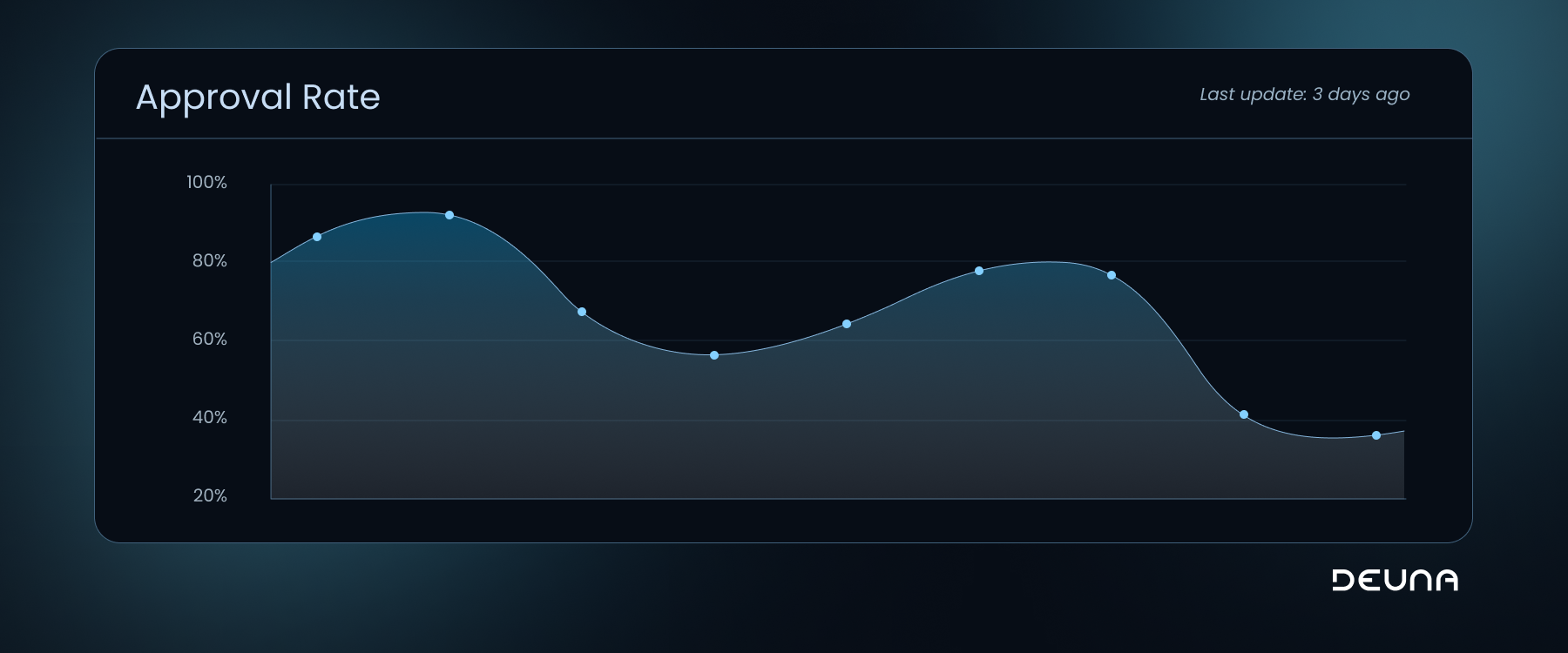
This is where agentic intelligence extends what reporting already does well. Reporting establishes that approval rates dropped four points last week, which is the necessary first step. Agentic reasoning takes that finding and works backward from it: which BIN ranges, which geographies, which processor, which decline codes, and what changed in the routing configuration before it happened.
That distinction has direct revenue consequences. Nearly half of merchants estimate that up to 5% of legitimate orders are incorrectly declined as fraudulent, representing an estimated $50 billion in lost revenue industrywide, according to PYMNTS Intelligence. Those declines are visible in the data long before they appear in a quarterly review. Finding them requires something that investigates continuously rather than on request.
The practical shift is speed and coverage. Questions that took a data team days to answer are answered in seconds. Problems nobody thought to look for get surfaced, because the system is not limited to the queries a human happened to run.
That is also what turns payments into a competitive position rather than a cost line. PYMNTS Intelligence reports that 61% of merchants consider payments a crucial area for competitive differentiation, particularly when they can use payment data to personalize customer experiences.
Athia applies this model to payments and commerce data: it unifies and structures the data, embeds business context and payments benchmarks, and uses an agentic reasoning engine to uncover root causes and growth opportunities, with specialized strategists working continuously on areas like acceptance rate optimization.