
For most finance leaders in travel, payments show up as a single line on the P&L: cost of acceptance. It is large, it is recurring, and it is rarely questioned. That last part is the problem.
Accepting payments costs the world's airlines more than $22 billion a year, and roughly 80 percent of that is payment fees, mainly tied to card acceptance. For an industry where the average airline earns about $7.90 in net profit per passenger on a net margin of around 3.9 percent, that is not a rounding error. It is one of the few cost lines a finance team can actually influence without touching fuel, fleet, or labor.
UATP is one of the levers sitting in plain sight. And most travel merchants barely look at it.
UATP (Universal Air Travel Plan) is a payment network built specifically for travel. It was established in 1936 as the Air Travel Card and is dedicated to travel-related expenses such as carrier and hotel costs, and it is owned and operated by the airline industry itself. Today it is accepted across more than 250 merchants and over 30 major international airlines, along with rail operators and travel agencies.
Unlike a consumer card network, UATP is designed around corporate travel. Accounts are typically held by a company rather than an individual, and they centralize and control air, rail, and travel-agency spend. The value proposition to merchants is direct: lower transaction costs than commercial card networks, plus detailed line-item reporting that makes travel spend easier to manage and reconcile.
That combination, lower cost and richer data, is exactly what should make UATP worth a closer look. So why does it keep getting missed?
Three reasons, and none of them are about UATP's merits.
First, it is invisible to the teams that usually shape the payments stack. Growth and product teams optimize the consumer-facing checkout, where global card networks and digital wallets dominate. A B2B travel rail does not show up in those conversations, even though corporate travel is a meaningful slice of revenue.
Second, corporate travel is still overwhelmingly paid by card. Around 90 percent of corporate travel payments run on cards today, and corporate payment alone accounts for about $7 billion of the airline industry's $22 billion payment bill. Many of these are long-standing, contracted, low-risk relationships paying through one of the more expensive rails available.
Third, and most practically, adding a payment method has traditionally meant another integration. Every new connection is engineering time, certification, maintenance, and a separate reconciliation feed. When the financial case for UATP meets the engineering cost of supporting it, the project usually stalls. The rail gets overlooked not because it lacks value, but because capturing that value looked too expensive.
Reframed as a finance decision rather than a checkout feature, UATP touches three things that matter to the bottom line:
The lesson is not "UATP beats cards." Cards are essential and are not going anywhere. The lesson is that the acceptance mix is a margin decision, and the cheapest transaction is the one routed to the lowest-cost rail that still gets approved. Treating every transaction as if it must run on the same network leaves money on the table.
The market is moving in UATP's direction. Global business travel spending reached a record $1.57 trillion in 2025 and is projected to rebound to 8.1 percent growth in 2026. The corporate segment UATP serves is expanding, not shrinking.
The network is also modernizing. In 2025, UATP expanded its reach through partnerships that integrate alternative payment methods and regional options through a single connection on its Ceptor platform. The direction of travel is toward consolidation: fewer integrations, more methods.
That shift matters because the old objection, "supporting UATP means another integration," is exactly the barrier that modern payment infrastructure removes.
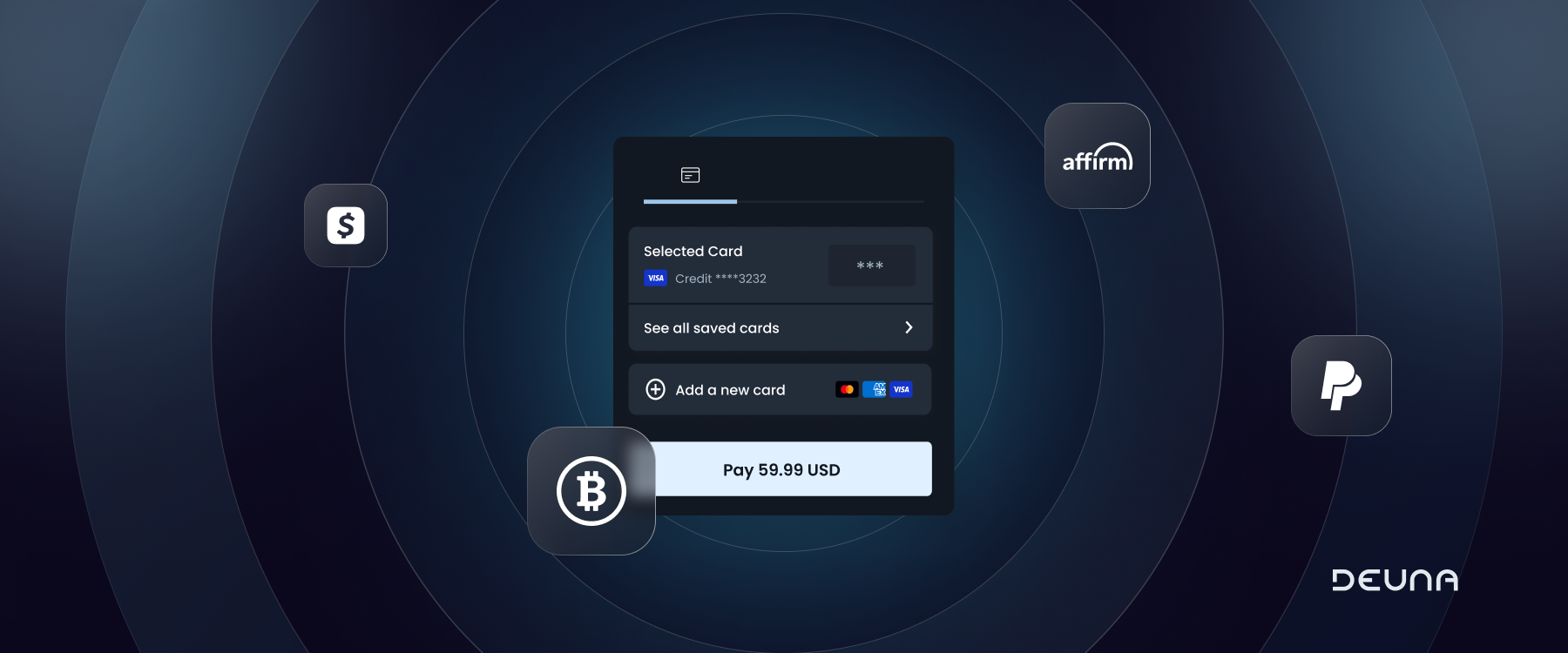
This is where the financial case and the operational case finally meet. Payment orchestration connects a merchant to many payment and fraud providers through one integration, then routes each transaction based on cost, approval likelihood, and context. Adding a method like UATP stops being a standalone engineering project and becomes a configuration step.
DEUNA connects enterprise merchants to more than 400 payment and fraud providers through a single integration, and UATP is one of them. Once you have your UATP credentials, enabling it inside DEUNA means adding it as a connection: you name the connection, decide whether to tokenize guest cards, choose whether to create settlements, and select the operation type, either purchase or authorization. There is no separate stack to build or maintain.
That last part matters beyond setup. Because the connection runs through the same layer as the rest of your payment methods, the settlement and line-item data UATP produces lands in one reconciliation view instead of a separate silo. The detailed reporting UATP is known for becomes usable finance data rather than another file to match by hand. Athia, DEUNA's payments intelligence engine, then reads across that unified data to identify when routing a transaction to a lower-cost or higher-approval rail actually improves the outcome, rather than leaving those calls to static rules.
In other words, the cost of supporting UATP is no longer the reason it has to stay overlooked.
UATP is not new or exotic. It has been part of travel payments since 1936. What is new is that the cost of putting it to work has dropped, while the pressure on travel margins has not.
That turns an overlooked rail into a straightforward question: which slice of your corporate travel volume is running on the most expensive network available, and what would it take to route it more intelligently? With UATP already available as a connection, adding it is no longer the hard part. The merchants who move first will protect margin on revenue they already have. Want to see how UATP fits into your payment stack with DEUNA?