Most enterprises ask the wrong question about fraud prevention: "which fraud engine is the best?" The better question is "best at what, for whom, which industry, what amounts?"
The answer is in your own numbers. No single engine wins at everything: one is sharper on high-ticket orders, another on a category like electronics, another in a specific market.
Run all your volume through one fixed engine and you quietly accept weaker performance on every segment where another would have done better. That gap is where revenue leaks, and closing it is exactly what AI was built to do.
To be clear, the anti-fraud providers are genuinely strong, trained on enormous datasets and far better than any human at spotting patterns. That is not in question.
What gets enterprises into trouble is asking one engine to handle everything the same way. Fraud does not behave uniformly: a $40 repeat purchase and a $4,000 first-time order carry completely different risk, and a loyal apparel shopper looks nothing like a first-time buyer of high-resale electronics.
Apply a single logic across all of it, and the engine ends up too strict where it should relax and too loose where it should tighten.
That mismatch is expensive in ways the fraud report never shows. According to the 2025 LexisNexis True Cost of Fraud Study, every $1 of fraud now costs US merchants $4.61 once chargebacks, fees, and recovery are counted, up 32% since 2022.
The harder cost is the revenue you never see, because the same study found that fraud controls themselves drive customer churn at 59% of US merchants. Adyen's 2026 report points the same way, with roughly 60% of merchants reporting more false declines, and Chargebacks911 concluded those false declines now cost more than the fraud they prevent.
The message is consistent: every order wrongly rejected by a blunt rule is a paying customer handed to a competitor. The goal, then, is not a better engine. It is sending each transaction to the engine, and the decision that performs best for that exact kind of transaction.
That question is where AI earns its place, and the role is worth stating plainly: it does not replace your fraud engines, it orchestrates them, acting as an uplift layer over the decisions they already make.
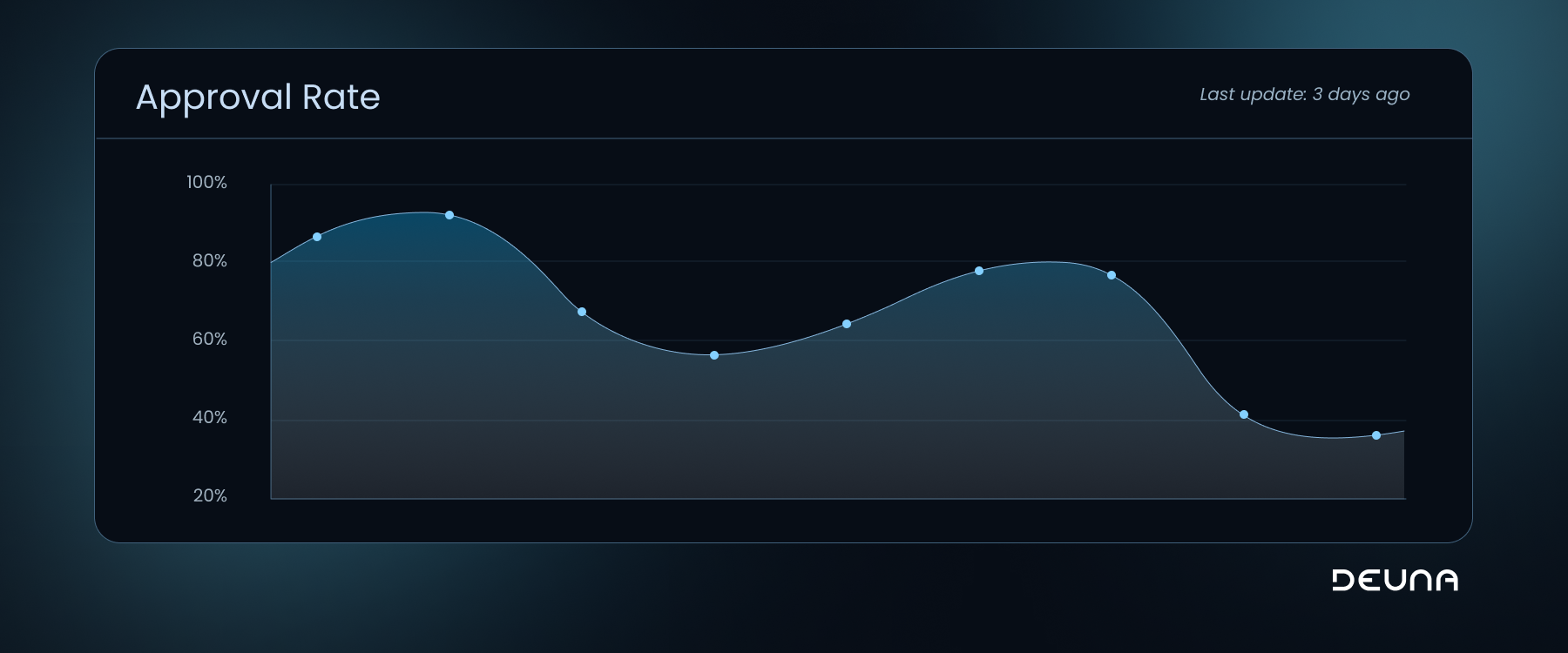
The system tracks the live performance of every connected engine, segment by segment, on the only KPIs that matter: approval rate against chargeback rate. High-value orders flow to the engine with the strongest approval-to-chargeback balance there; a category like electronics flows to whichever engine handles it better.
Clean segments are approved with no friction, elevated risk triggers 3DS rather than an outright block, and clearly fraudulent patterns are denied. The engines keep doing what they do best, scoring risk, while the AI decides which one to trust and what to do with that score.
Because it relearns as the numbers move, the routing sharpens every week instead of drifting out of date, and it stays governed throughout: clear action limits, audit trails, role-based permissions, and controls aligned with local regulations.
Picture two orders arriving at once. The first is a modest, familiar purchase from a repeat customer, so it routes to the engine with the strongest approval record for that segment and clears instantly.
The second is a high-ticket first-time order in a resale-prone category, so it routes to the engine that handles that risk best and is met with 3DS rather than a decline.
One customer never feels a thing, the other is verified instead of turned away, and both outcomes protect revenue, none of it resting on a single engine being right about everything.
The old instinct was to find the single tool that stops the most fraud. The enterprises pulling ahead ask a sharper question: which tool, and which decision, performs best for each kind of transaction they actually see.
That reframes fraud prevention from a wall into a routing decision. Your engines are not the problem, and they are not in competition. The opportunity is to put each to work exactly where it wins, guided by live data on approvals and chargebacks rather than a rule set fixed when the year began.
This is the shift DEUNA was built to make real. By connecting the fraud engines you already trust on one neutral layer and letting Athia route each transaction to the one that performs best for its segment, fraud prevention stops being a blunt gate and becomes a living decision that compounds in your favor.
The number worth watching was never how much fraud you stopped. It was how much good business you approved, sent to the right engine, at the right moment, with DEUNA making sure that decision keeps getting smarter.