
Most enterprise payment teams operate in reactive mode. A processor goes down, someone scrambles to reroute. Approval rates drop in a key segment, and it takes days to identify the cause. A new payment method gains traction in the market, but enabling it may require several weeks of engineering work. The team spends its time fixing what already broke instead of proactively identifying where performance can improve and acting on it before revenue is left on the table.
This is not a people problem. It is an infrastructure problem. And agentic AI is purpose-built to solve it.
Agentic AI systems do not just assist. They act. They plan sequences of actions, execute them across multiple systems, and adapt based on outcomes without requiring human intervention at every step.
This distinction matters because most enterprise AI has not delivered on its promise. McKinsey's State of AI 2025 report tells a revealing story: 88% of organizations now use AI in at least one business function, yet more than 80% report no tangible impact on enterprise-level EBIT. Only about 6% qualify as high performers seeing real financial returns. The pattern is consistent across industries. Companies adopted chatbots and copilots that help individuals work faster, but those tools do not transform the processes where value is actually created or lost. A chatbot helps an analyst draft a report. It does not monitor approval rates across five processors, detect a spike in declines, reroute transactions automatically, and flag the pattern for review.
That is precisely the gap agentic AI closes. Applied to payments, it transforms the function from a cost center that reacts to failures into a strategic capability that continuously optimizes performance, improves acceptance rates, and identifies growth opportunities before they become visible in a weekly report.
Because the data they need to act proactively is trapped in silos, and the processes to make sense of it are still largely manual.
The typical enterprise merchant uses multiple processors, each with its own dashboard, reporting format, and definitions. When something goes wrong, the team pulls data from each provider manually, normalizes it in spreadsheets, and diagnoses the issue after the fact. By the time they identify the root cause, the revenue is already gone. And with the number of variables involved in payments, from processor behavior and card types to geographies, payment methods, and fraud signals, doing this at scale is simply not possible without the right systems.
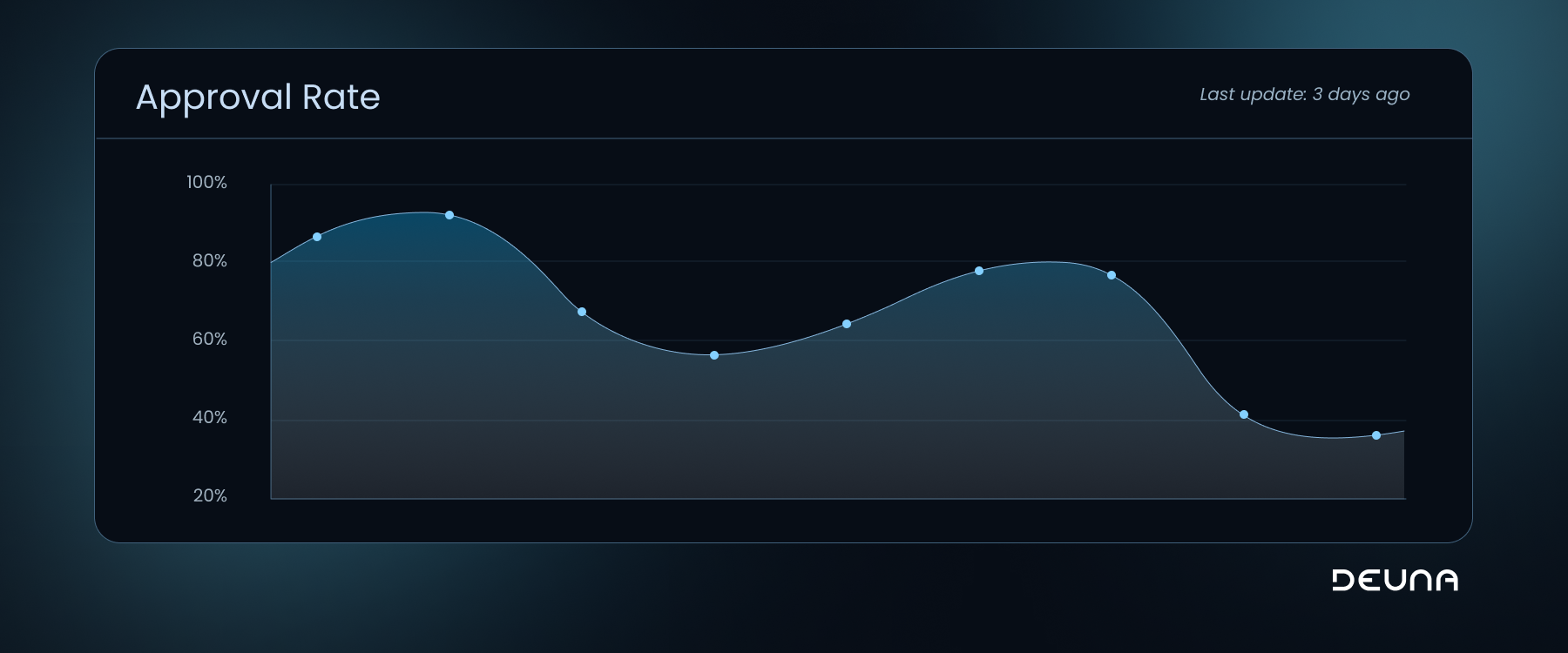
An agentic system changes this entirely. Consider a scenario: approval rates for a specific BIN range drop 4% through Provider A over the past six hours. In a traditional setup, this pattern surfaces days later in a weekly report, if it surfaces at all. An agentic system detects the drop as it happens, evaluates whether Provider B or C performs better for that BIN range, reroutes affected transactions automatically, and sends the team a clear summary of what changed, what it did, and why. The bleeding stops the moment the pattern emerges, not days later when someone happens to notice.
Because every hour of delay has a dollar amount attached to it.
In marketing, a slow optimization cycle costs efficiency. In payments, it costs revenue, transaction by transaction, in real time. And the stakes are rising. US card processing fees reached $198.25 billion between 2024 and 2025, according to the Merchants Payments Coalition. Every basis point of unnecessary cost and every recoverable decline that goes undetected represents direct margin erosion.
The challenge is that the variables driving those outcomes, processor performance, BIN-level approval rates, routing logic, fraud thresholds, and cost per transaction, change constantly and interact with each other in ways that are impossible to track manually at scale. A payment team reviewing performance in weekly meetings and adjusting rules by hand cannot keep pace with a landscape that shifts daily. Agentic AI can, because it monitors, decides, and acts continuously, not on a human schedule.
Closer than most payment leaders realize, and the window to act is narrowing.
Gartner predicts that 40% of enterprise applications will include task-specific AI agents by the end of 2026, a dramatic jump from less than 5% in 2025. That pace of adoption signals that agentic AI is moving from innovation labs into core business operations within a single year. McKinsey's survey confirms this trajectory: 62% of organizations are already working with AI agents, and 23% are scaling them in at least one business function.
In payments specifically, the shift is accelerating even faster. Visa predicts that millions of consumers will use AI agents to complete purchases by the 2026 holiday season. Mastercard completed its first live agentic payment transaction in September 2025. The card networks, processors, and platforms are all building infrastructure for a world where AI agents are not just assisting commerce but initiating it.
The gap between experimenting and scaling remains wide, and it comes down to infrastructure. The organizations that will see real returns are those whose underlying payment stack can support autonomous decision-making at the speed and scale that payments demand.
DEUNA is already applying agentic AI to payment operations through Athia, her payments intelligence engine.
Athia is not a dashboard. She is an agentic, ML-powered reasoning engine that works across checkout, payments, and fraud data from every provider in your stack. She identifies where approval rates are leaking, why, and what to do about it, before the problem reaches a monthly report. Built on DEUNA's orchestration platform, which connects over 400 providers through a single integration, Athia turns reactive payment operations into continuous optimization