Every transaction today starts with a person browsing, comparing, and clicking buy. That model is changing faster than most payment teams realize.
According to McKinsey, agentic commerce could redirect $3 to $5 trillion in global retail spend by 2030, with the US B2C retail market alone representing up to $1 trillion in orchestrated revenue. That is not a distant projection. Visa predicts that millions of consumers will use AI agents to complete purchases by the 2026 holiday season. The opportunity is already forming. The merchants who build the right infrastructure now will capture it. Those who wait will not.
AI agents that discover, compare, and buy on behalf of consumers are moving from pilots to real transactions. For merchants, this raises one immediate question: is your payment infrastructure ready for a customer that is not human?
Agentic commerce changes the transaction initiation model entirely. Intelligent agents make purchasing decisions within predefined parameters and trust boundaries, triggering payments without a human present at checkout.
This is already happening. According to Visa research conducted with Morning Consult in October 2025, 47% of US shoppers already use AI tools for at least one shopping task. Adobe tracked a 4,700% year-over-year increase in AI-generated traffic to retail websites through mid-2025. OpenAI and Stripe co-authored the Agentic Commerce Protocol, which allows users to complete purchases within ChatGPT without leaving the chat. Google launched its Agent Payment Protocol in September 2025, backed by Mastercard, PayPal, American Express, Adobe, and Alibaba. The rails are being built right now.
When an AI agent initiates a transaction, the behavioral signals that fraud systems rely on disappear. There is no browsing behavior, no session history, no biometrics. The transaction arrives without the contextual signals that current risk models use to distinguish legitimate purchases from fraud.
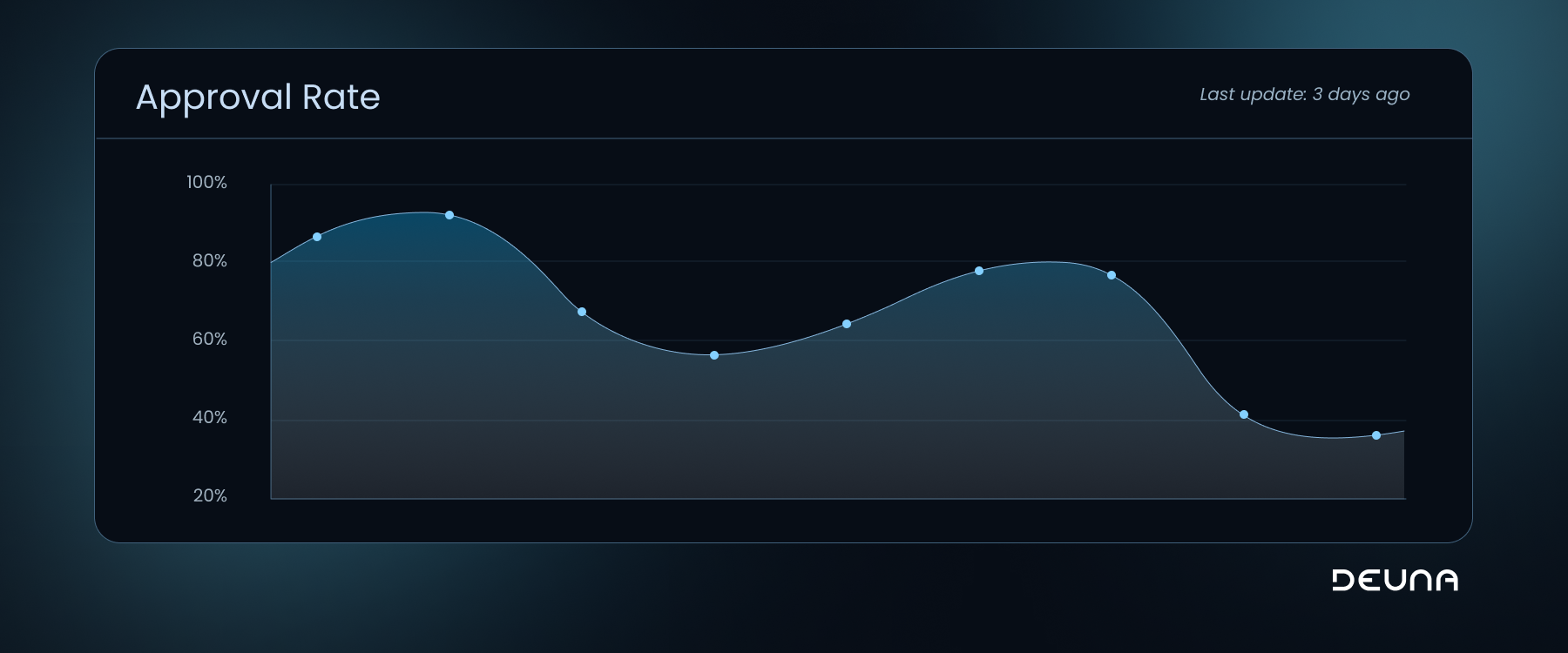
But here is the deeper problem: most merchants cannot make smart decisions on human-initiated transactions today. According to PYMNTS Intelligence, 47% of merchants estimate that up to 5% of legitimate orders are wrongly declined as fraudulent, generating an estimated $50 billion in annual revenue losses. False declines cost US merchants approximately $118 billion annually in legitimate orders wrongly blocked, according to ClearSale. If static rules cannot handle human transactions reliably, they will not survive agent-initiated ones at scale.
Merchants with fragmented data, single-provider dependencies, and rule-based routing will face compounding losses as agent-initiated transaction volumes grow.
Agentic commerce disrupts a foundational assumption of current payment infrastructure: that identity, intent, and authorization are explicit and observable because a human is present. When an AI agent is the initiating party, the payment stack needs to verify not just the cardholder, but the agent acting on their behalf.
This requires three things your payment stack must be able to do.
Identify what is initiating the transaction. Fraud systems built around human behavioral signals need to evolve to handle machine-initiated traffic. Visa and partners introduced the Trusted Agent Protocol in October 2025 precisely to help merchants distinguish between malicious bots and legitimate AI agents acting on behalf of consumers.
Assess risk in real time with incomplete behavioral context. Without session history or biometrics, risk models need to rely on transaction-level data: card type, amount, merchant category, issuer behavior, and historical performance. This requires a unified data layer across all payment providers, not siloed data from individual processors.
Route intelligently based on context. An agent-initiated transaction from a new device in an unfamiliar location may look different from a human transaction to the same issuer. Smart routing that accounts for these variables and automatically retries through alternative providers is essential for maintaining approval rates as transaction profiles evolve.
Why orchestration is the starting point for agentic commerce
The infrastructure requirements for agentic commerce are not fundamentally different from what high-performing merchants already need today. The difference is that the margin for error shrinks significantly when the customer is an agent operating at speed and scale, with no human available to retry or switch payment methods if something fails.
According to a PYMNTS Intelligence report commissioned by Visa Acceptance Solutions, integration cost stands out as the primary challenge for merchants, cited by more than half of acquirers as the top obstacle to deployment. Merchants still managing fragmented data across PSPs and static routing rules will face the highest friction as agent-initiated volume grows.
Payment orchestration addresses this directly. A single integration layer that connects multiple providers, routes transactions dynamically based on real-time parameters, and automatically retries through backup gateways when a transaction is declined removes the complexity that makes agentic commerce operationally difficult. It also provides the unified data layer that risk models need to make decisions without relying on behavioral signals that agent-initiated transactions simply do not carry.
Orchestration handles the infrastructure layer. But in an agentic commerce world, where transactions arrive without behavioral context, at speed, and with no human to intervene, infrastructure alone is not enough. You also need a system that can make sense of what is happening across all of those transactions and continuously adapt based on what it learns.
This is where intelligence becomes the differentiator.
DEUNA connects merchants to 400+ global payment and fraud providers through a single integration, with orchestration logic that adapts dynamically to the transaction context, whether it comes from a human or an AI agent. Athia, DEUNA's payments intelligence engine, builds on top of this by ingesting data across checkout, payments, and fraud tools to identify approval blockers, detect revenue leaks, and optimize routing in real time. In an environment where transaction patterns shift rapidly and no human is in the loop, a system that learns and adapts continuously is not a competitive advantage. It is a requirement.
This shift can move faster than prior commerce revolutions. The protocols that enable agent-initiated transactions are being built right now, and the merchants who establish the right infrastructure before they become standard will have a significant advantage. Those who wait will find that both AI agents and the shoppers behind them route their purchases somewhere else.
The payments stack you build in 2026 determines whether you are positioned to capture this growth or watch it go to a competitor. Ready to see how DEUNA helps merchants get ready?