.png)

Payments teams today are not struggling with a lack of tools. They are struggling with how decisions are made.
That was the central idea behind DEUNA's recent webinar hosted by the Merchant Risk Council, where Mark Wallick, VP of Product at DEUNA, and Svante Westerberg from Xsolla explored how agentic payments intelligence is changing the way enterprises improve approval rates, manage risk, and reduce operational workload. Here are the key takeaways from the session.
Most payments conversations start with infrastructure: how many PSPs you have, which payment methods you support, how your routing is configured. But those conversations miss the deeper issue.
As payment ecosystems scale, merchants accumulate payment methods across multiple providers, regions, and channels. The infrastructure problem gets solved. The decision problem does not. When data is fragmented across systems, teams spend their time stitching together reports instead of acting on them. By the time a performance issue is identified, the revenue has already leaked.
According to the MRC's 2026 Global eCommerce Payments and Fraud Report, 63% of merchants are actively exploring or planning to implement agentic AI payments. That number indicates a fundamental shift in how payment teams expect to operate: with greater speed, precision, and intelligence at every stage of the transaction lifecycle.
At scale, manual processes do not just slow you down. They cost you revenue.
Operating across multiple providers, regions, and channels creates a burden that goes beyond processing transactions. The real cost is maintaining visibility. Data cleaning, reconciliation across providers, and identifying performance drops are all manual, time-intensive processes. Teams are not spending their time optimizing. They are spending their time maintaining. And by the time issues surface in a weekly report, the optimization window has passed.
This is what fragmentation looks like in practice. Not a technical inconvenience, but a structural drag on revenue performance. Most merchants are not dealing with a cost problem. They are dealing with a hidden revenue leakage problem that does not show up on any P&L.
The gap between insight and action is where revenue is lost, and intelligent decisioning is how you close it.
Most payment teams operate in a reactive mode: dashboards tell them what happened, and teams respond. The problem is that authorization decisions happen in under 200 milliseconds, according to industry benchmarks from Mastercard's Decision Intelligence documentation. By the time a human sees a trend in a report and adjusts a rule, thousands of transactions have already been processed under the old logic. Few teams have what could be called action loops: the ability to see data, understand it, and act on it in a closed cycle before the opportunity is gone.
Intelligent decisioning closes that gap, moving payment operations from a detect, investigate, patch, repeat cycle to one where systems observe signals, make decisions dynamically, and continuously learn from outcomes. This is not about replacing human judgment. It is about removing the latency between insight and action so that teams can focus on strategy rather than firefighting. And it changes four things that matter most:
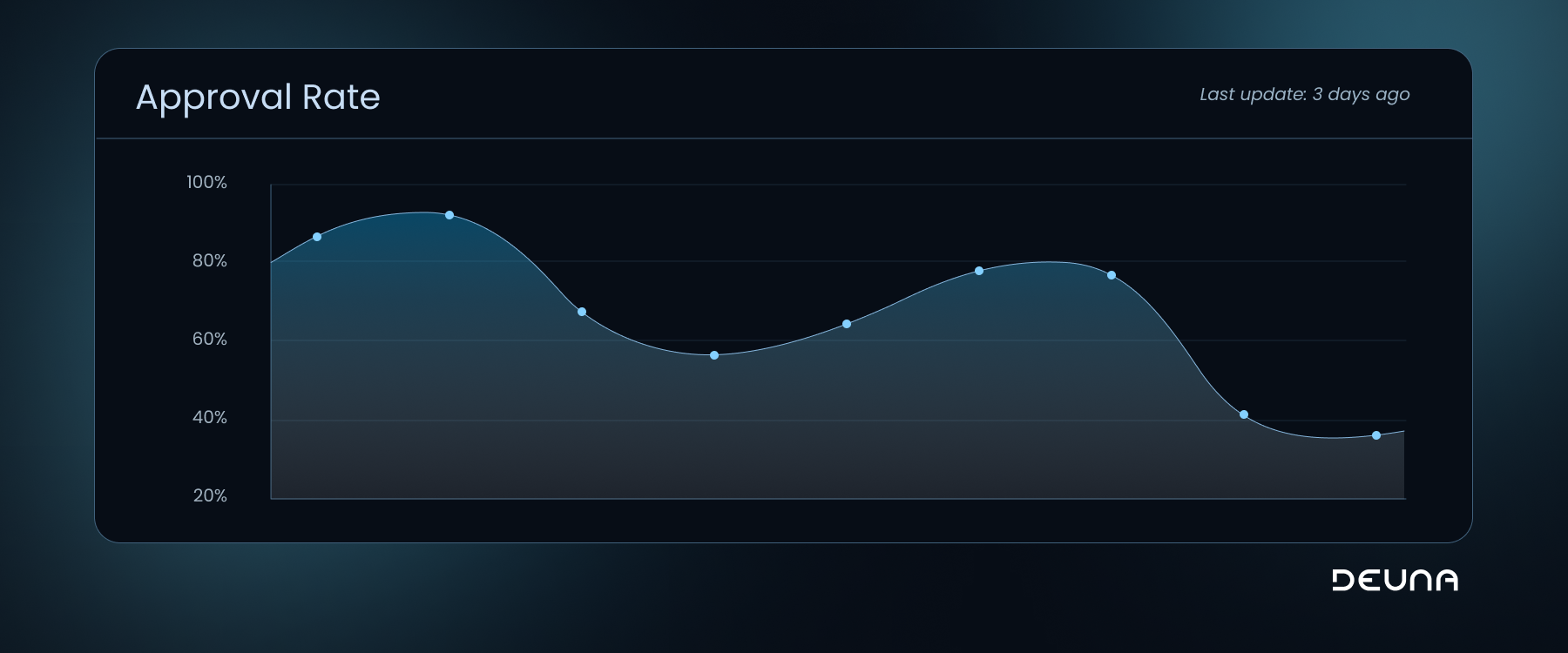
Approval rates improve. Today, most routing decisions are based on rules that were configured weeks or months ago. By the time conditions change, the rules have not. An intelligent system evaluates each transaction in the moment, accounting for how a specific issuer is behaving right now, what the risk signals are saying, and which routing path is most likely to succeed. The result is more approvals, not because the rules got better, but because the system stopped relying on rules alone.
Fraud strategy becomes sharper. Static fraud logic creates a persistent problem: it blocks legitimate transactions that do not fit the expected pattern, while missing fraud that does.
Intelligent systems do not rely on fixed thresholds. They adjust dynamically based on live signals, which means fewer false declines hitting good customers and fewer gaps that fraudsters can exploit.
Operational workload drops significantly. Every hour a payments team spends on manual root-cause analysis or rule updates is an hour not spent on strategy. When decisioning is automated at the transaction level, that work shrinks. Teams stop maintaining the system and start directing it toward higher-value problems.
Intelligence does not require replacing your infrastructure.
A common concern is whether moving to intelligent decisioning means rebuilding the payment stack. The answer is no. The value of agentic intelligence is precisely that it layers on top of existing infrastructure. Merchants do not need to replace their PSPs or rebuild their orchestration setup.
They need a unified data layer that consolidates signals across providers, and an intelligence layer that can act on those signals in real time. The integration problem is largely solved. The intelligence problem is what comes next.
Complexity in payments is not going away. The number of providers, payment methods, and markets will continue to grow. The question is not how to simplify the ecosystem, but how to make better decisions within it, faster, and at scale.
That is the shift agentic intelligence enables. And for the merchants who are still running on manual optimization cycles, the gap between what they are capturing and what they could be capturing is growing every quarter.