
The 2026 World Cup kicked off on June 11 in Mexico City and runs through the July 19 final at MetLife Stadium outside New York. For the first time, the tournament spans three countries, 48 teams, and 104 matches across 16 host cities in the United States, Canada, and Mexico.
For payments teams, this is more than a sporting event. It is the largest live test of cross-border commerce North America has ever run, and it is happening right now.
Allianz Trade estimates the event will draw roughly 6.5 million attendees, including 2.6 million international visitors, over a six-week window. Travel-data firm Data Appeal, working with Mabrian and PredictHQ, forecasts around 4.3 billion dollars in event-related tourism spending, with more than 80 percent of it concentrated in hospitality.
Almost none of that happens in cash. All 16 stadiums are operating as fully cashless venues, accepting only cards and contactless payments, with Visa serving as FIFA's official payment technology partner. And the buying starts long before kickoff: fans book flights, hotels, and tickets online, weeks ahead and almost always with a card issued in another country.
Flight booking data from Sojern, reported in June, showed year-over-year increases of roughly 13 percent in Houston, 10 percent in Dallas-Fort Worth, and around 8 percent in Miami and New York. Every one of those is a foreign card meeting a checkout it has never seen before.
When a card issued in São Paulo or Seoul books a hotel in Kansas City, the issuing bank sees a transaction outside the cardholder's normal pattern: a new country, a different currency, often a high-value, card-not-present reservation.
Issuers respond with caution, and they have reason to. In their joint reporting on payment fraud, the European Central Bank and the European Banking Authority have consistently found that fraud concentrates in cross-border payments. Most card fraud by value involves cross-border transactions: around 65 percent in 2019, rising to about 71 percent by the first half of 2023, even though cross-border makes up a much smaller share of overall card volume.
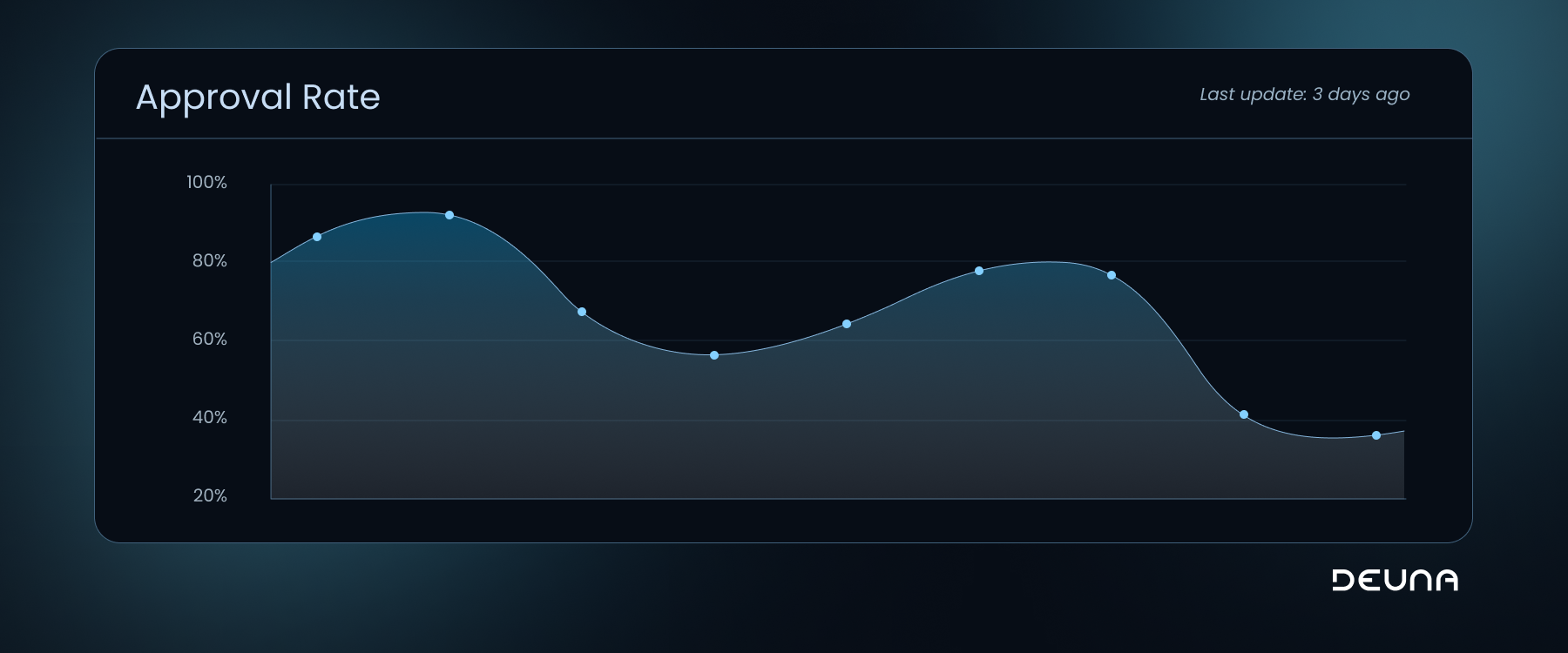
The problem is that the caution is often wrong. Checkout.com reports that nearly half of merchants see up to 5 percent of their payments wrongly declined as fraud, and those false declines climb in cross-border acquiring, where the issuer has less context on the cardholder. Research from Checkout.com with Oxford Economics estimated that businesses lose as much as 2.1 percent of revenue to poor payment performance and false declines.
And the damage outlives the sale: Checkout.com found that 35 percent of cardholders are likely to abandon a merchant after a decline. For a fan who just flew across the world, a declined hotel deposit at midnight is the moment trust breaks.
The merchants who convert foreign-card volume and the ones who leak it are rarely separated by which processor or fraud engine they use. They are separated by how much control and visibility they have over the full transaction flow.
What recovers the sale is routing each transaction to the provider that performs best for that corridor, applying authentication like 3D Secure where it lifts approvals rather than adding blanket friction, and retrying recoverable declines instead of treating every rejection as final.
That is the layer DEUNA is built to be. As a payment orchestration platform, DEUNA does not replace the processors or fraud tools a merchant already trusts. It coordinates them, so each operates where it is strongest. Athia, DEUNA's agentic payments intelligence layer, sits behind that flow and turns it into answers: she surfaces why approval rates dropped for a specific card type in a specific market, or where authentication is adding friction instead of protection, in the time it takes to ask.
The World Cup will end. The economics it exposed will not.
Merchants who treat their cross-border approval rate as a fixed cost will keep paying it, quietly, on every declined sale. Those who treat it as an infrastructure decision they can see, understand, and improve will keep the revenue the others lose.
The tournament offered a rare, large-scale look at what borderless commerce demands. The smart move is to study the lesson now, while the games are still on.